Dallas, TX
Access Control Gate Systems in Dallas, TX
Morrison Gate & Fence integrates entry-control options with automatic gate systems at residential and commercial property entrances in Dallas, where the gate, the operator, and the equipment that grants entry are suited to each other.
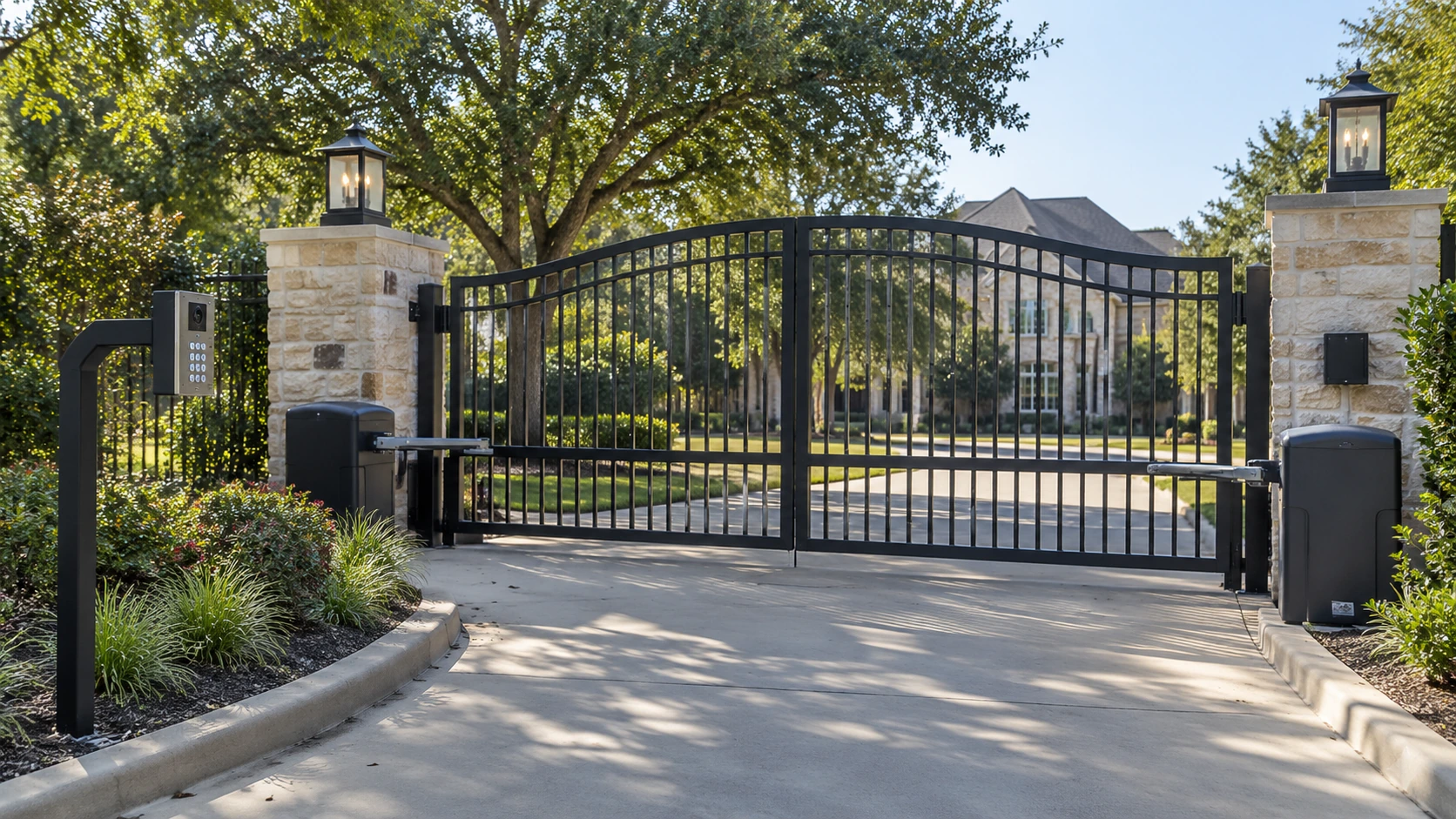
Gate Access Control Systems for Dallas Properties
Access control is the part of a gated entrance that decides who gets through. The gate provides the barrier and the operator does the moving; access control supplies the command that tells the operator to open, and only when someone is authorized to send it. Once you separate those roles, most questions about gate entry become easier to answer.
The command can come from several places. A remote in a vehicle suits people who arrive regularly. A keypad accepts a code, so it works for anyone who has been given one without handing out hardware. Telephone entry and intercoms take a different approach entirely: the visitor asks, and someone inside decides. Where the operator supports it, credential-based devices such as card or fob readers cover staff and tenants who need individual access.
In practice a property often uses more than one. Everyday drivers carry remotes, a keypad handles guests and service visits, and a telephone or intercom unit covers people who were not expected. The mix depends on who arrives at your entrance and how much you want to manage that yourself — which is what this page walks through for Dallas properties.
Gate Keypads and Entry Controls
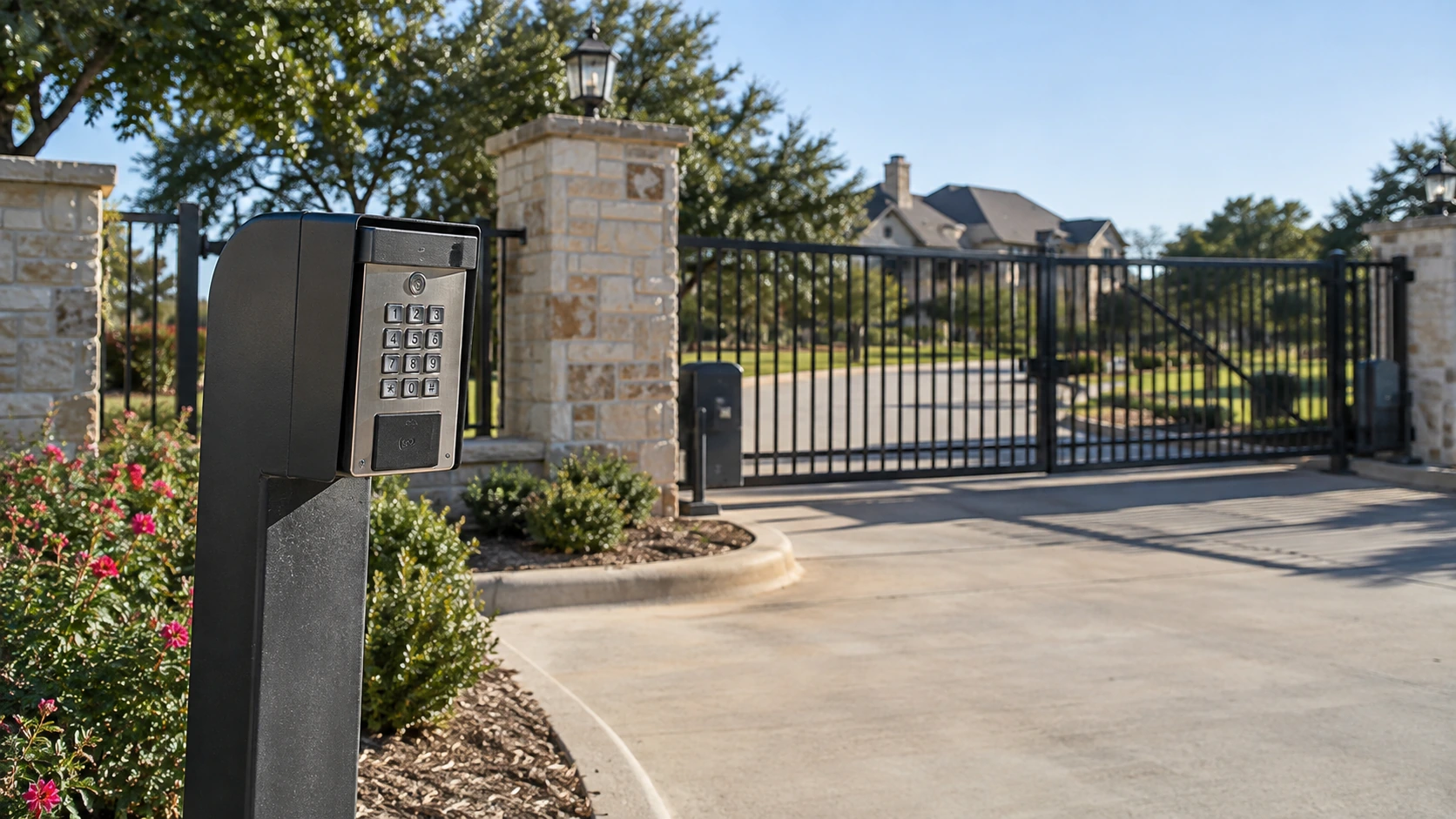
A keypad grants entry to whoever knows the code, which is its strength and its limitation. Nothing has to be carried, lost, or replaced, and a code can be shared with a house sitter or a landscaping crew for the afternoon. It also means a code circulates once shared, so codes are worth changing when the group of people using the entrance changes.
On a residential driveway the keypad usually serves visitors while the household uses remotes. On a commercial entrance it more often serves staff and regular vendors, and where the equipment supports separate codes per user, a code can be issued or removed for one person without disturbing anyone else.
Placement matters more than people expect. The unit needs to sit where a driver can reach it without leaving the vehicle, clear of the gate's travel path, at a height that works for both cars and trucks, and somewhere power and its connection to the operator can reasonably run. We install entry equipment as part of the gate system and make no claims about security certification or ratings for it.
Telephone Entry and Intercom Systems
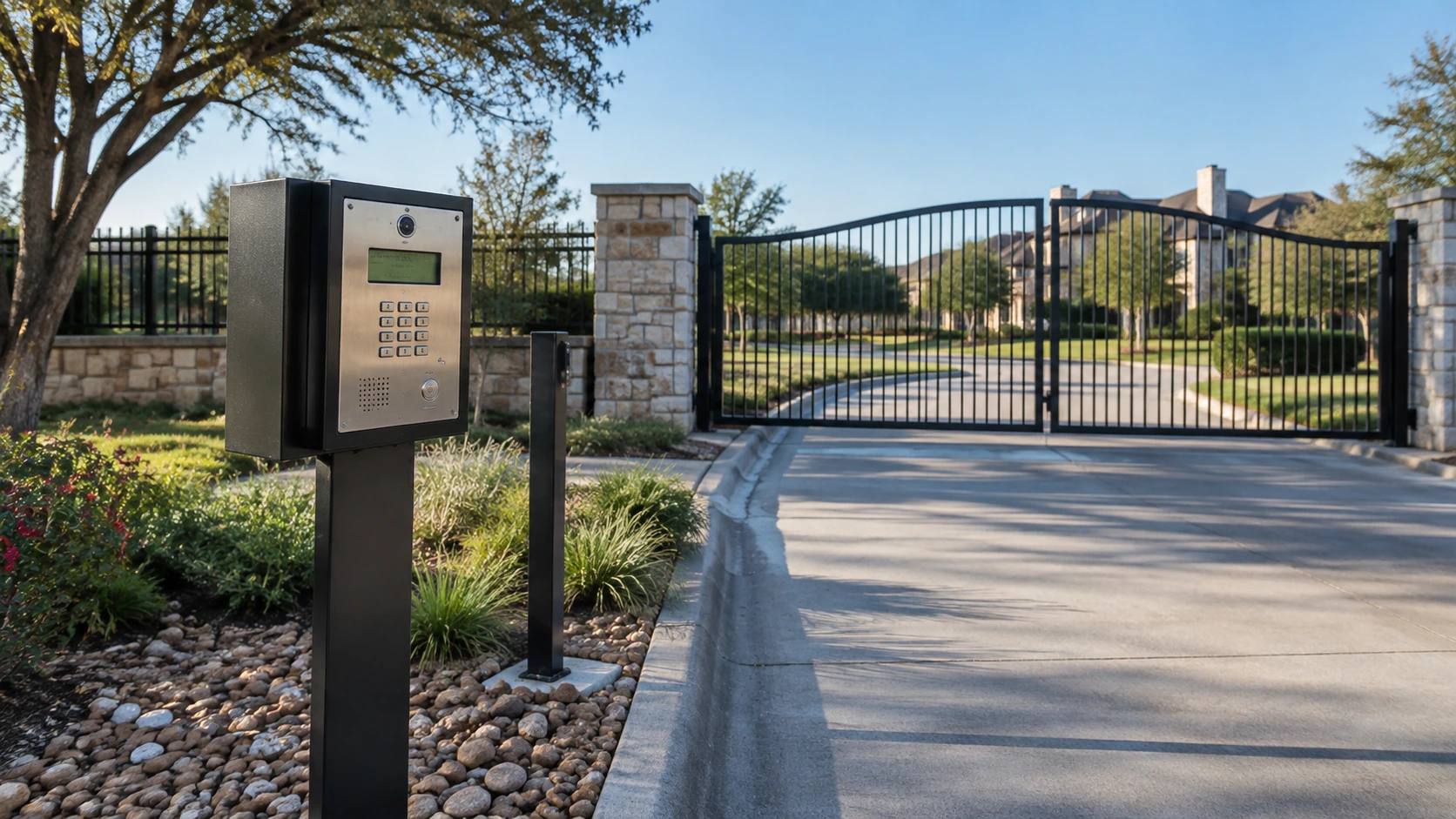
Keypads and remotes answer the question in advance: whoever holds the code or the transmitter is already approved. Telephone entry and intercom systems answer it in the moment. A visitor makes contact at the entrance, someone inside speaks with them, and entry is granted or declined on the spot. That suits properties where you cannot know in advance who will turn up.
The practical use cases are familiar: a delivery driver who has never been to the property, a contractor arriving for a first visit, a guest at a multifamily entrance who needs the right resident, or a commercial site where the person at the gate should be identified before the gate moves at all.
On the gate side, these units work the same way any other entry device does — once entry is approved, a signal goes to the operator and the gate cycles. The difference is upstream, in how the decision is made and how the system reaches the person making it. Capabilities vary by equipment, so what a particular system can do at your entrance is confirmed against the hardware rather than assumed.
Commercial Gate Access Control in Dallas
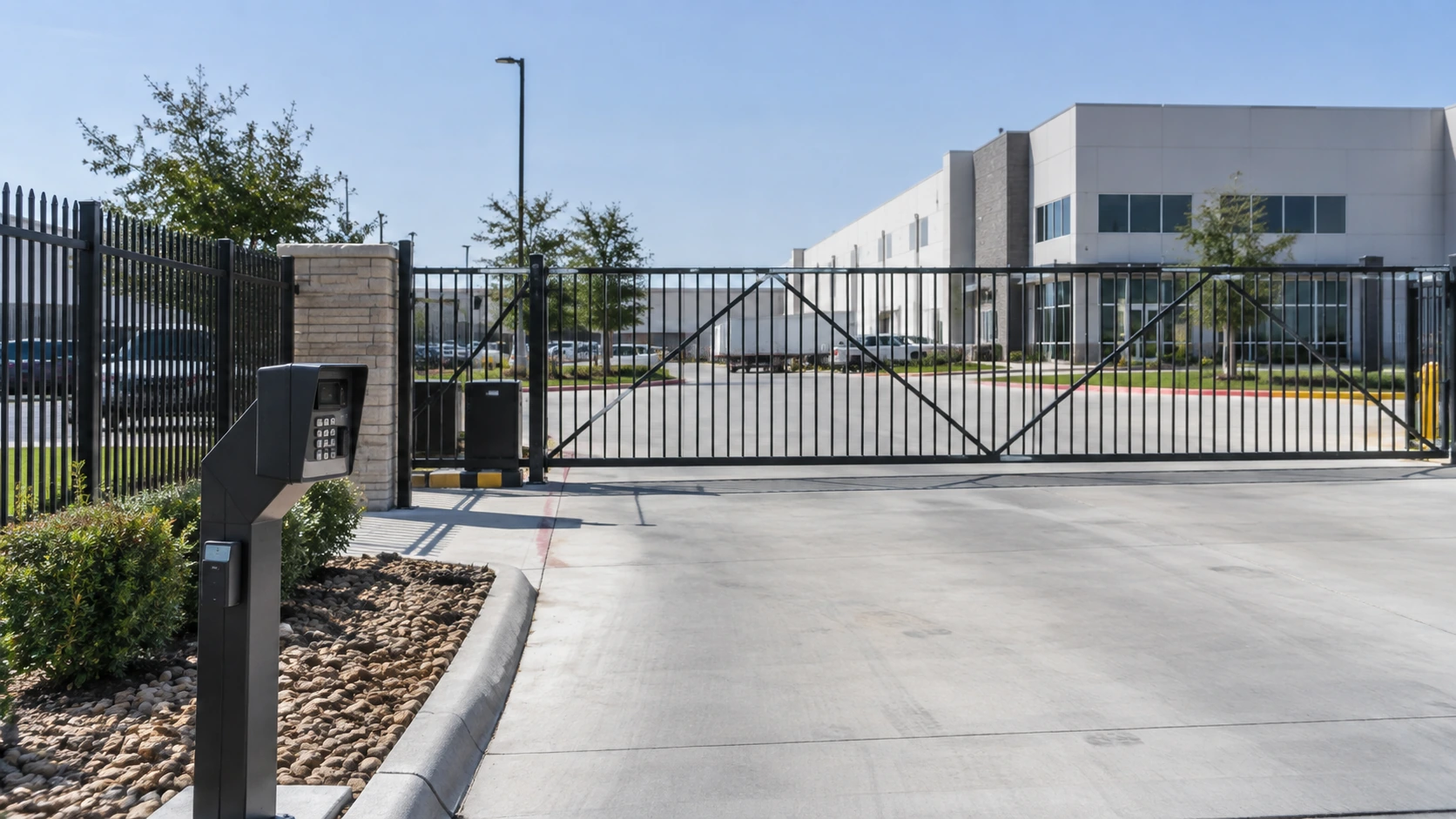
Commercial entrances usually have to distinguish between groups rather than simply between inside and outside. Staff, tenants, vendors, and visitors may all need through the same gate under different terms, and people join and leave those groups over time. That is why access on a business entrance is planned around administration — who can be added, who can be removed, and who does it — as much as around the devices themselves.
Property types where this commonly applies include commercial buildings, warehouses and industrial sites, apartment and multifamily entrances, storage facilities, controlled parking areas, and fenced commercial yards. These are examples of where gate access control is typically used, not claims about work completed at any named business.
Duty cycle shapes the choice too. An entrance that runs constantly puts more demand on both the operator and the entry equipment than one used a few times a day. More on commercial gates; if an existing business entrance has already stopped responding, our Dallas commercial gate repair page covers diagnosis.
Residential Gate Access Control
At a home, access control is mostly about convenience and about visitors. The household wants to arrive and leave without stopping, which points to remotes. Everyone else — guests, deliveries, cleaners, pool or lawn services — needs a way in that does not require handing out hardware, which is where a keypad code or an intercom comes in.
An automatic driveway gate is the foundation for all of it, since every entry method ultimately talks to the operator. Homeowners planning a gate are usually deciding the entry method at the same time as the gate style and operator, because the three affect each other. See our residential gates and driveway gates services, or the Dallas driveway gate installation page if the gate itself is still being planned.
Integrating Access Control With Automatic Gates
Every entry device does the same thing at the end: it presents an open command to an input on the gate operator. The operator then runs its own cycle — checking its limits, its safety devices, and its settings — and moves the gate. Keypads, remotes, readers, and telephone entry units differ in how they decide to send that command, not in what the operator does afterwards.
This is why compatibility is a question about the operator. How many inputs it has, whether it supports a given device, how the device receives power, and how its signal reaches the cabinet all determine what can be added. Safety devices sit outside that chain and do a separate job: they can stop or reverse a gate regardless of who authorized entry, so a gate holding open may be responding to a sensor rather than ignoring a valid command. Background on automatic gate systems. We do not claim certification or affiliation with any gate-operator manufacturer.
New Access Control Installation vs. Repairing an Existing System
Four different requests often arrive described the same way. Adding a new access-control system means there is currently no entry device, and one is specified and installed for an existing gate. Upgrading an existing system means entry already works but the equipment is being changed or extended — a keypad added alongside remotes, or an older unit replaced.
Troubleshooting is different again: the equipment is installed but the gate is not responding to it, and the work is finding where the signal path breaks. And repairing the gate or operator is a separate job entirely — the entry device may be working perfectly while the operator, controls, or gate hardware are not.
Knowing which of the four you need helps us send the right information and arrive prepared. For the service overview, see gate access control and gate repair. For gates that are already faulty in Dallas, our automatic gate repair and commercial gate repair pages cover diagnosis in more detail.
Choosing a Gate Entry System
There is no single right answer here, and any recommendation that arrives before the entrance has been looked at is a guess. These are the factors that usually decide it:
- Residential or commercial use, and how the entrance is managed day to day
- How many people need access, and whether they are the same people each day
- Whether visitors, deliveries, or contractors need a separate way in
- The existing gate and operator, and what entry inputs it supports
- Keypad codes versus telephone or intercom entry, or a combination
- Entrance layout: where a vehicle stops, reach from the driver's window, and power routes
A home with two drivers and occasional guests has different needs from a multifamily entrance with turnover, and both differ from a yard gate used by a handful of employees and a stream of deliveries. The useful starting point is describing who arrives at the gate in a normal week, and what already exists at the entrance. If a new gate is part of the plan, our Dallas sliding gate installation page covers the gate side of that decision.
Access Control Gate Systems FAQs
Can a keypad be added to an existing automatic gate?
Often, yes. What decides it is the operator already on the gate: whether it has an input for an entry device, whether power and a wiring or wireless path can reach the keypad location, and whether the existing controls are still supported. The gate and operator are checked first, since the keypad only sends a command — the operator has to be able to act on it.
Can a gate use both a keypad and remote controls?
Commonly it does. Most operators accept more than one entry input, so residents or staff can carry remotes while visitors and deliveries use a code at the keypad. The practical limits are how many inputs the operator supports and how the devices are wired or paired to it, not the idea of mixing methods.
How does a telephone entry gate system work?
A visitor at the entrance selects a directory entry or dials a stored contact, the system places a call to the person inside, and if that person grants entry the system sends an open command to the gate operator. It is two functions in one unit: communication with the visitor, and a controlled signal to the gate.
Can access control be added to a residential driveway gate?
Where the gate is automated and the operator supports it, yes. Homeowners often combine remotes for everyday use with a keypad for family, guests, or service visits. On a gate that is currently manual, automation comes first — there has to be an operator for an entry device to control.
Why does my gate not respond to the keypad?
Either the keypad is not sending a valid command, or the operator is not acting on one. Power to the keypad, its connection or pairing to the operator, a changed or removed code, and the operator input itself are the places to look. If remotes still work and the keypad does not, that narrows it toward the keypad and its link to the operator.
Can an existing gate access system be upgraded?
Sometimes the entry device is replaced or added to while the gate and operator stay as they are; sometimes the operator is the limiting piece and has to be addressed for newer equipment to work with it. We look at what is installed, how the entrance is used, and who needs access before suggesting either path.
Access Control Gate Systems in Dallas
We work on gate entry systems across Dallas and the wider DFW area, on residential driveways and on commercial entrances alike. Entry equipment lives outdoors, so local conditions are part of the planning: summer heat on enclosures and backup batteries, heavy rain around exposed units and low-mounted devices, and the ordinary wear of a pedestal that is reached from a car window several times a day. Those are general conditions, not claims about work at any named property.
For the full range of fence and gate work in the city, visit the Dallas service area hub.
Planning a Gate Access Control System in Dallas?
Tell us what gate and operator are at the entrance, who needs to get through, and whether visitors arrive unannounced. Photos of the entrance and any existing entry equipment help us prepare.